April 4 - 2018 Tucson, Arizona


The last 3 days we have been on a major move westward. Driving, driving and even more driving.
Monday, we drove 315 miles/ 500 km from San Antonio, Texas to Fort Stockton, Texas
Tuesday, we drove 290 miles/ 460 km from Fort Stockton, Texas to Las Cruses, New Mexico
Wednesday, we drove 350 miles/ 560 km from Las Cruses, NM to Tucson, Arizona with a little detour to Tombstone, Arizona
We stayed on I-10 all the way.
Not much happened aside from driving and stopping for the night, but we did pick up a lot of different impressions along the route. Very different.
The following is a mix of some of what we came across on the almost 1000 miles / ca. 1600 km long drive.

Roads blasted through rocky hills in west Texas
 
Oil wells (JJ wants one of these in the back yard)
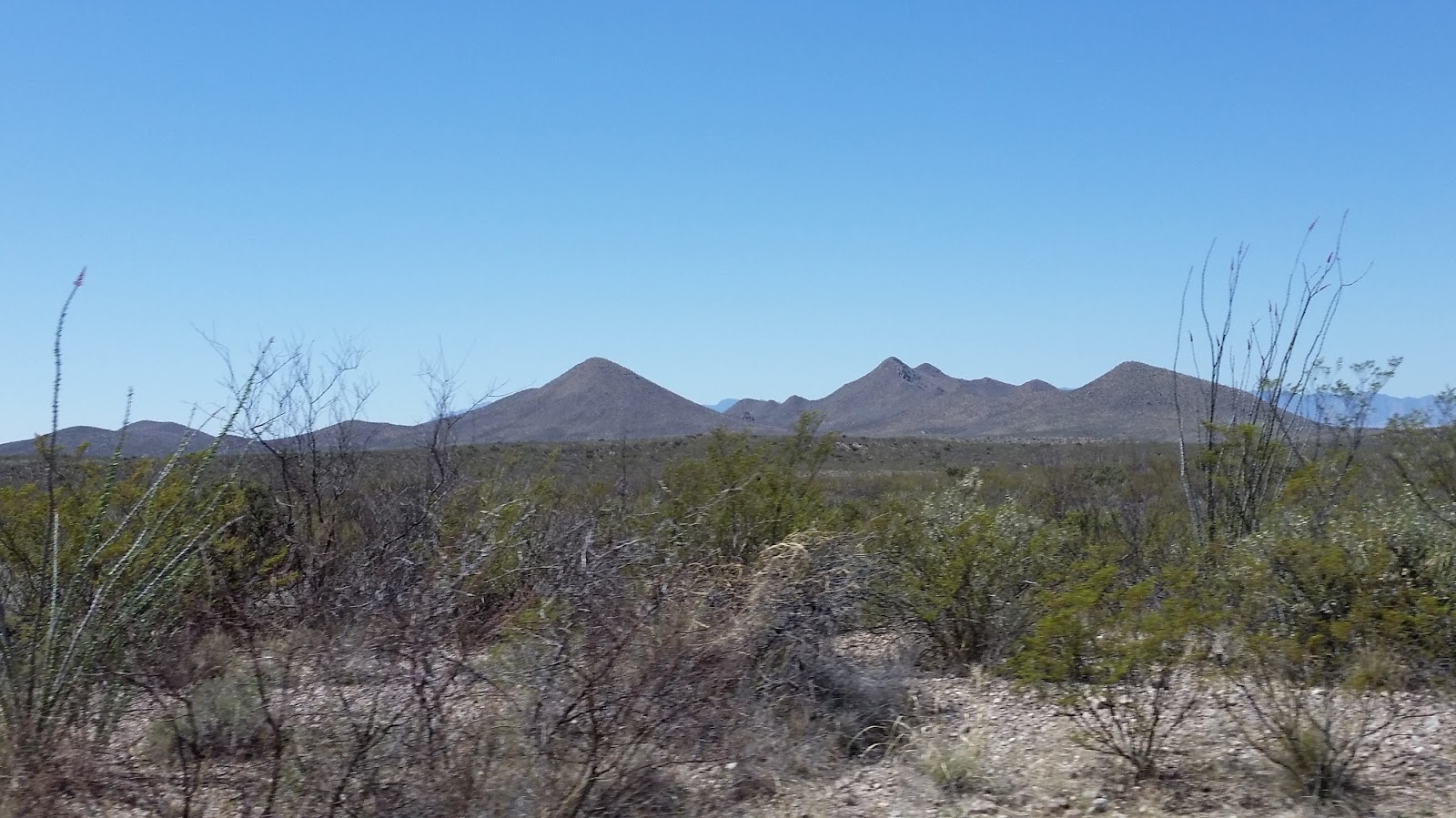
The hills became flat plateaus in the west Texas wind.
And the landscape became dryer.

New Mexico was even dryer.
This is a dry river wash (udtørred flod).

The hills turned into rugged mountains.

We had to stop for a train. It had 115 cars and 4 engines.

 
We were warned about dust storms and rattle snakes.  
 
At one point, the mountains became huge rocks.

This huge rock looked like it was going to fall at any minute.
 
And then there were mountains again.
We were close to the Mexican boarder twice.
We thought for sure that they would search the camper,
but they looked at 2 old people and their Minnesota plates and waved us through :-)

We saw big cactuses.
 
A whole "forest" of cactus
 
We saw so much barren(ufrugtbart) land. No wonder that the ranches are huge.

I (JJ) talked to a neighbor when we stayed at Las Cruses. His grandfather had a ranch that was 10 000 acres
( ca 4000 hektar) and he thought that he had about 500 pieces of beef cattle (kødkvæg) on it.
That is 20 acres ( 8 hektar) a piece !!
The guy, by the way, was a welder (svejser) and had moved temporarily with a camper to Las Cruses.
He was on an eight month contract welding a 20 miles fence/wall  (23 feet (ca. 7 m) tall) at the Mexican border,
filling a gap on the already existing fence.


When we crossed the border from Texas to New Mexico we saw big pens (folde) with cattle. It went on for over a mile and there must have been thousands and thousands of them. We thought it was some kind of marketplace. Found out later that they were milk farms.

On the whole trip we have been impressed with the rest stops along the interstates and have been meaning to comment on it.
We are not talking commercial stops (gas stations, restaurants etc.). They are nice too.
But the non-commercial, run by authorities (myndigheder). They are big, with lots of parking space, big spotless clean bathrooms, pretty buildings, covered picnic areas etc. etc. New Mexico was no exception.
(The ones we know from Europe can not even be compared to this standard. In Europe (Denmark included)
 we have been known to stop and then move on with unsolved business for sanitary reasons)
 
 
We are now staying at Justin’s Diamond J campground in Tucson. And again, we were positively surprised. At only $ 31.00 per night a large site for the camper. Full hookup and probably the best wi-fi we have had throughout the whole trip. Mountain view right behind the camper. And the weather is perfect (almost too hot): 90 F / 32 C, some clouds and a nice breeze.
 
This cactus in in our back yard. We estimate
that it is about 30 feet (10 meters)
 
Written by JJ and Mary

April 1 - 2018 San Antonio, Texas

 
We are so grateful, that neither of us has pollen allergies. The pollen count is high in Texas right now. We were surprised to hear, that oak (eg) was the biggest problem at this time of year. We had never heard of a problem with oak pollen. It turns out, that “southern live oak”, is a very different kind of oak, than we are used to from Denmark and Minnesota. The trees grow very big, and get very old, and they have acorns (agern), as we are used to; but they look much different. And they give off A LOT of pollen in the spring. (Even people who don’t have allergies are bothered, because everything outside gets a coating of yellowish green pollen.)
The yellowish color on the trees is pollen


Today (April 1) is Easter Sunday (påskedag). I wanted to go to church, so we decided to go see “the missions” and go to church there.
Thousands of years ago, the area was populated (beboet) by the Tejas Indians. They were hunters and gatherers. In the 1600’s, Spanish explorers started moving in from the south, bringing with them diseases (sygdomme). The Tejas had no resistance (modstand) against these new deceases, and therefore died in big numbers. At the same time another threat appeared. The  Apache Indians came from the north. They were very aggressive, so the Tejas people decided to seek protection provided by the Spanish missionaries.

Missions were built for the purpose of converting the Indians to Christianity, and to help protect them from the Apache. Unfortunately, living at the missions increased the amount of disease among the Indians, and 70-80% of them died. The ones who did survive (overlevede), had to learn a new way of life. They were taught how to farm, and many European skills – such as building with bricks, milling, weaving, blacksmithing….
Five missions were built in the area that is now San Antonio. The Alamo was one of them (San Antonio). The other 4 are Conceptión, San Jóse, San Juan, and Espada. They were all towns, built with a church as the most important building, and walls around the town, as protection from invaders. No one lives in these mission towns now (except San Antonio, where the modern town grew up around the mission). But all of the churches still survive and are all used (except the church at the Alamo). The other buildings and outer walls, are in varying states of repair.


The Spanish taught the Tejas' how to irrigate (kunstig vandning).
Here they built an aqueduct to transport the water.


It was Easter! At this mission, they had used one of
the ruined walls, to hide Easter eggs. We guess the
kids were going to hunt for eggs after mass.
 

Living quarters for the Tejas


We ended our tour of the missions at the church of San Jóse. There was a Mexican sounding band (3 guitars, a harp and not least a trumpet), and a choir singing songs in Mexican. The service was very lively and different than any other, we have been to.


Written by Mary

March 31 - 2018 San Antonio, Texas


San Antonio is one of the few places in the USA that Mary has already seen. She wanted to go there again, and also give me the chance to see it. That was a good choice. However, we did not know that this year’s NCAA Final Four in Basketball (Mesterkab for universitetshold) for men was taking place in San Antonio this week-end! Also called March Madness. There were lots of people and many streets were blocked off. We decided to try to beat the crowds and went in very early. That turned out really well.


The main attraction in San Antonio is the Alamo.


The Alamo was a Spanish Mission from 1724 to 1793.
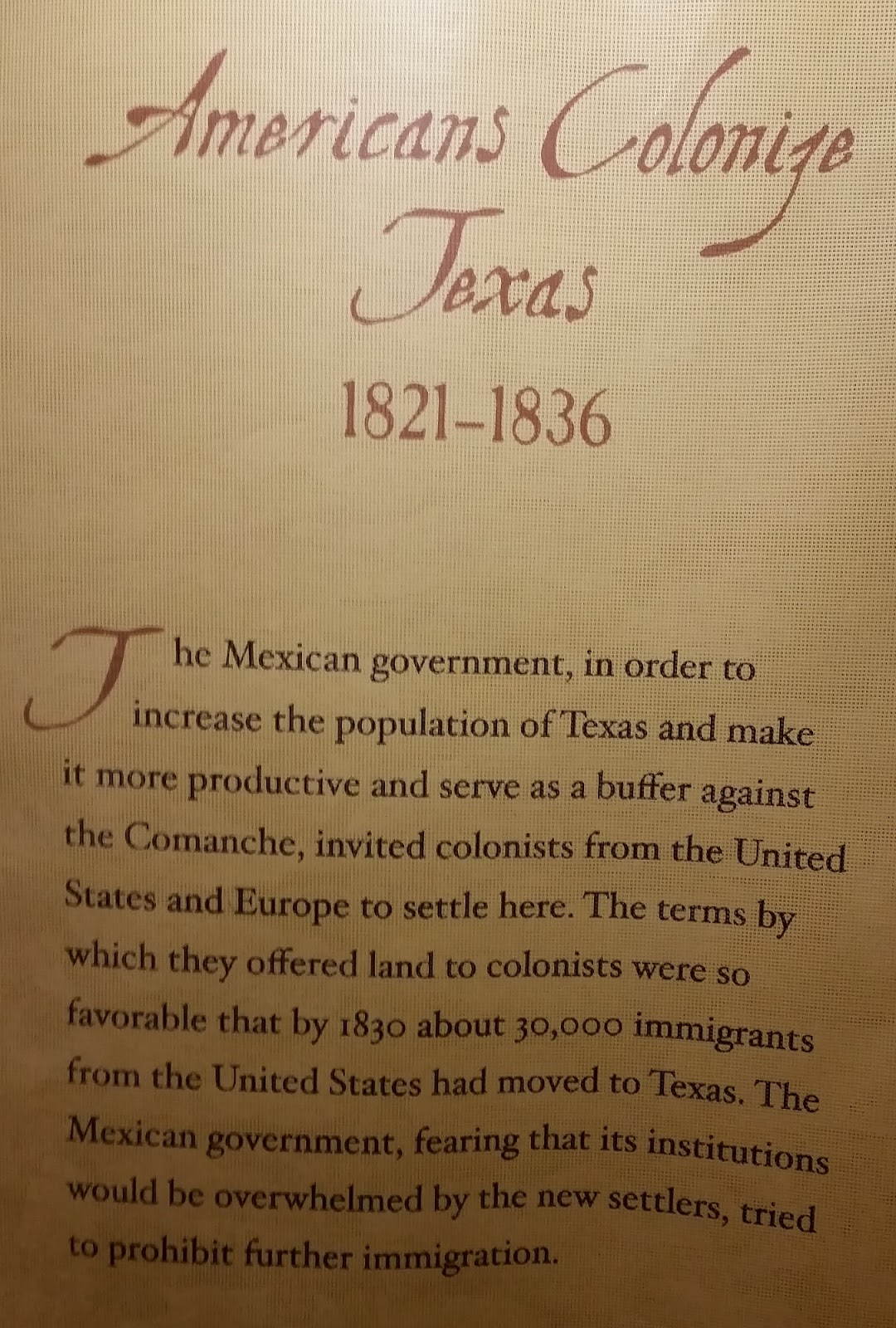
Later on it was used as quarters (barakker) for Spanish Soldiers. Originally, Texas was a Spanish colony as was Mexico. When Mexico got its independence in 1821, Texas was part of Mexico with certain privileges of self-rule. The Mexicans wanted to make Texas more productive, and also increase the population in relation to opposing the native Comanche Indians. In order to do so, the Mexican government invited settlers from the USA to come to Texas. By 1830, there were 30.000 Americans and only 3000 Mexicans. By 1835, the American settlers wanted independence (uafhængighed) from Mexico.
At the end of that year the Texas rebels managed to take over the Alamo.
President of Mexico, General Santa Anna himself, led an army in order to crush (knuse) the rebellion.
 
On February 23rd, 1863 he started a siege (belejring) of the Alamo. 13 days later, on March 6th, he attacked and killed almost everybody (spared a few women, children and slaves) It was a massacre.
189 people were killed/slaughtered and afterwards burned. I would say that 80% of them were from the US. 1 from Denmark! One of them was one of my boyhood heroes: Davy Crocket.

General Sam Houston was the leader of the Texas revolution. After the Alamo, Santa Anna went after Houston’s army to finish off the rebellion. The two armies met on April 21st, 1863.
It was in that battle that the famous phrase was coined, as the soldiers yelled as they attacked: “Remember the Alamo”. Houston won the battle. Santa Anna was captured, and in order to spare his life, he had to acknowledge the independence of Texas. Sam Houston became the first president of the Republic of Texas. Texas joined the United States in 1845, as the 28th state.  

I could not help thinking, again, about immigration. If you allow massive immigration, you run a great risk of letting the immigrants take over your country and your culture. It has been seen many times before, like here, and it can happen again. If you believe your country and its values are worth keeping, you may want to let immigration happen at a speed where the immigrants will assimilate (tilpasse sig) to your culture, instead of taking it over. My political statement of the day! 😊
Too little - too late
 

Another attraction in San Antonio is the River Walk. Every city we have been to, that has had a river, has had a river walk.
Well after San Antonio I will not be impressed, not even close.
The San Antonio River Walk is something else. The project started almost a hundred years ago, and has been developed ever since.  It is 2½ miles (4 km) long. On both sides of the river there are shops, restaurants, flowerbeds, lots of trees, waterfalls etc. etc. Twenty some bridges cross the river. It is incredible.


Written by JJ

P.S.
We ran across this wedding party being photographed in front of the Alamo.