June 4 - 2018 West Yellowstone, Montana


Yellowstone – day 2:
Monday, June 4, we did the north loop in Yellowstone (70 miles/110 km). We got started early in the morning, hoping to see some of the park’s wildlife. We were hoping to see more, but we did see a mule deer, a pika (small rabbit like amnimal), a grizzly bear, a pair of trumpeter swans, and more bison. Most of the animals were a little too far away to capture on camera, but we did get these.

Mule deer
This time we got real close to a calf.
 
Again, we saw:

Mountains and lakes
 
Waterfalls

And lots of hydrothermal activity:

Mammoth Hot Springs (where the hot water carries minerals to the surface, creating incredible shapes and colors)


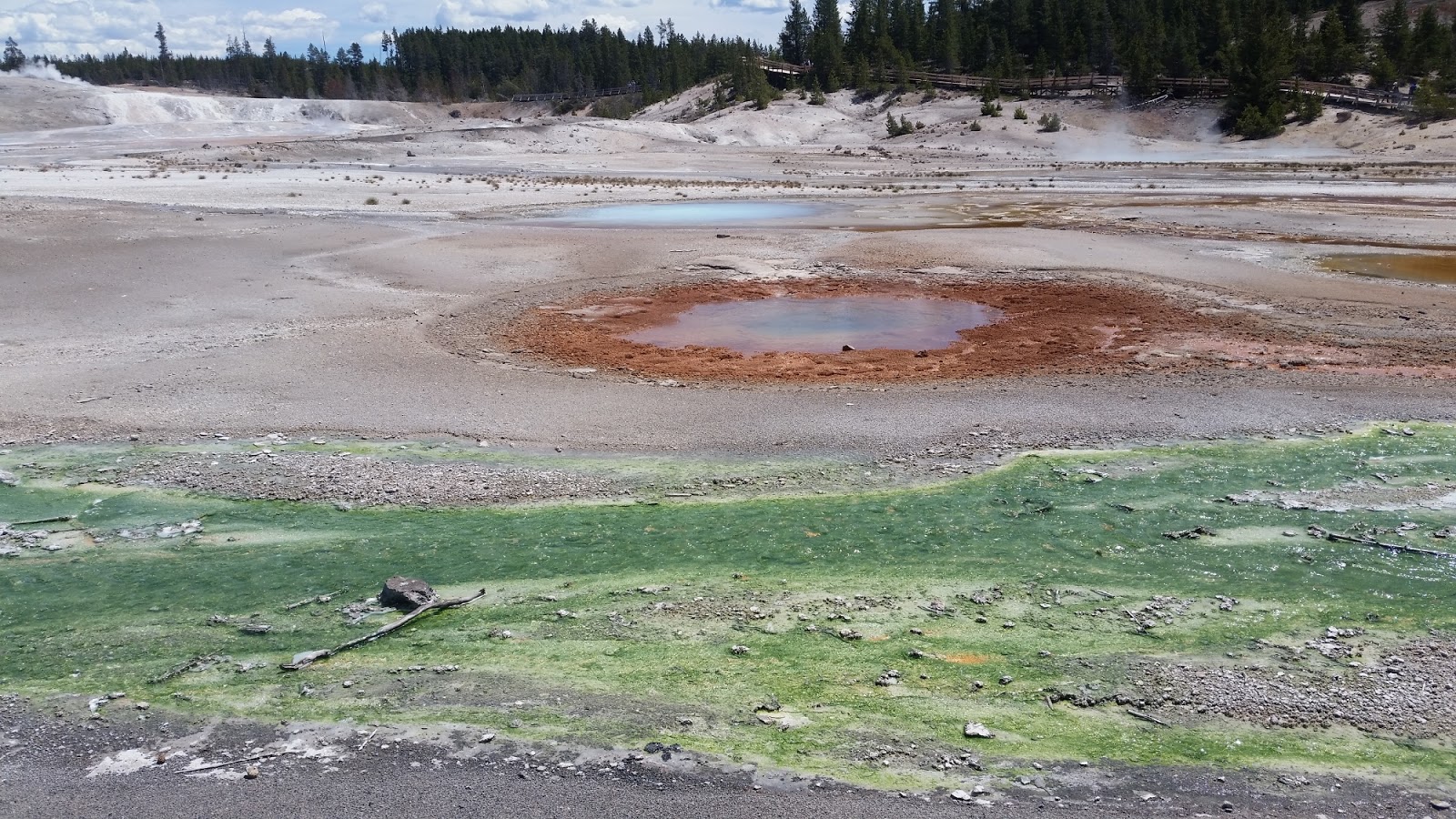
Porcelain Basin (where silica creates milky colored water, and thermophiles and minerals create all the colors of the rainbow)


This place was like “no place we have every been before”. It was hard to believe that we were in nature.
It looked artificial, with all the different colors. (You might be able to tell, that this was my favorite place)
Steamboat Geyser
This geyser sounded like a large steam engine roaring!
Aside from all the hypothermic things we saw, we also experienced them with our other senses. We heard lots of sizzling, bubbling, gurgling, hissing, roaring. We felt the heat from the steam and the earth. We also felt the mist coming off some of the geysers. And most of all, we smelled sulfur everywhere (even when we got home!). We could even taste it on our lips.

We were both very impressed with Yellowstone National Park. We would recommend anyone to visit it.
We are so happy we could. It will DEFINITELY be on our top ten list!

Written by Mary

June 2-3 - 2018 West Yellowstone, Montana

Saturday, the 2nd, we moved from Cardwell to West Yellowstone, Montana (130 miles/ 210 km).

If Washington DC was on JJ’s must-see list, Yellowstone National Park was on Mary’s.
Sunday we went to Yellowstone. We are camping just half a mile (800m) from the East Entrance of the Park.
That is in Montana, but right after the entrance you enter Wyoming, in which more or less the whole park is located.
Yellowstone National Park was the first national park in the US (1872) and also the first national park in the world. It is huge. 3500 square miles (9000 km2). That is as big as Delaware and Rhode Island combined(Sjælland+Lolland+Falster).

The park is located on top of a huge volcano. A third of the park is a caldera (krater) from the last eruption about 600,000 years ago. The caldera is 45x28 miles (72x45km) which also indicates the force of the eruption. It is believed to be 1000 times larger than the eruption of Mt. St. Helens in Washington State in 1980.

The volcano is still considered active and when it erupts again (next month? or in 500,000 years), it is going to have a massive impact on life, not only in the US, but the whole world.

The National Park Service has done a great job of making the attractions easy to get to (as usual – impressive). The road in the park is in a figure 8. Sunday, we did the lower part of the 8. That part alone is 95 miles /150 km, which gives you an idea of the size of the place.


The park has a lot of all kinds of nature. Some we have seen before, like…

Mountains and lakes
Yellowstone Lake
Rivers
Fire Hole River
Waterfalls
Lower Falls of the Yellowstone Canyon
Canyons
Yellowstone Canyon
The Continental Divide 😊


There were also some new things. Even though we have seen some volcanic things (Mt. Lassen, Crater Lake, Newberry National Volcanic Monument), we had not seen any active volcanic activity. There is a lot of it in Yellowstone!
A large portion of the park has hydrothermal activity. Warm water and minerals (such as sulfur) are pumping up from the underground, creating many strange and fascinating things. There are signs everywhere, warning people to stay on pathways. The water is VERY hot (sometimes boiling), and VERY acidic (syre). It can dissolve a pair of boots in no time! People have been badly injured. It was VERY tempting to get closer to some of the things, but we kept to the paths😊


There are lots of geysers
The most famous of the geysers, and probably the best-known attraction in Yellowstone is Old Faithful (sådan ca. “gamle trofaste”) It erupts (er i udbrud) relatively regularly, between 65 and 90 minutes (depending on the length of the last eruption). An eruption lasts 2-5 minutes and it shoots an average (gennemsnitlig) of 5000 gallons (knap 20.000 liter) an average of 145 feet (44m) into the air.
The National Park Service predicts the next eruption(+- 10 minutes)  online, so we didn’t have to wait long.

Here Old Faithful is to the left

Old Faithful


Hot springs


Mudpots/volcanos - Like boiling mud

 
Thermophiles (heat-loving bacteria) create colorful edges on pools and streams.
This is called "Artists paint pots" because there are all different colors


And, we saw lots of buffalos (bisonokser)! 

This guy was only 3 feet (1 meter) from the car.
We would not have gotten that close, if we were not in the car!
There were lots of calves in the herd.
Written by JJ and Mary

June 1 - 2018 Cardwell, Montana

Friday, June 1st, we did nothing but driving.
A long move ( 400 miles/ 640 km) from Steptoe, Washington to Cardwell, Montana. It was a bit strenuous, because of a lot of roadwork and, for at least the first two thirds, hills and mountains and a lot of climbs and declines and curves. Plus a little rain.
But it was also a pretty drive and Mary managed to capture some of it.
(It is amazing that a "telephone" can take that kind of pictures while you are driving 55-60 mph /88-96 km/t).

This is Mt. Powell


The clouds were as beautiful as the mountains
 
We passed the continental divide one last time

We are staying at a small campground in Cardwell (30 miles/ 50 km) east of Butte.
If their advertising is to be believed, Lewis & Clark camped here .
😊

Not for long I don't think, because the mosquitos (myg) are pretty bad.😊

Luckily we have been mosquito free for over 2 months. No good thing lasts forever. ☹

Written by JJ

May 31 - 2018 Steptoe, Washington

A few weeks ago, my sister Michelle, sent us a link to “The 20 most beautiful places in America”. When we looked at the pictures, we found that we had seen many of them already. Others we had chosen not to see, had already passed, or were not going to be near. Three places caught our attention, because we were going to be close to them, and they looked like something we might want to see.

One of the places was Multnomah Falls, which we saw yesterday. The other two were Palouse Falls and The Palouse, which we decided to see today (May 31). They are both in the state of Washington, and near each other. We drove northeast 290 miles/450 km to Steptoe, Washington.

The Palouse Falls and surrounding river gorge (flodens kløft) were created by the ice age. As the ice melted, it flooded the area many times, forming this deep gorge (kløft). Today the Snake River runs here.


The area is called the Palouse, which is a hilly area in Washington and Idaho, created by glaciers millions of years ago. The strangely rolling hills were created by sand, which came from the ice grinding stones into fine particles. The sand blew and created these mounds. The sand was fertile (frugtbar), so grass grew readily on it. The landscape is strangely beautiful, and today it is the best farming land in Washington.


Must be a farmer's nightmare!

We drove up Steptoe Butte (a small mountain in the middle of the hills), to view the Palouse from above.
We were taken by the beauty of the place.


Written by Mary